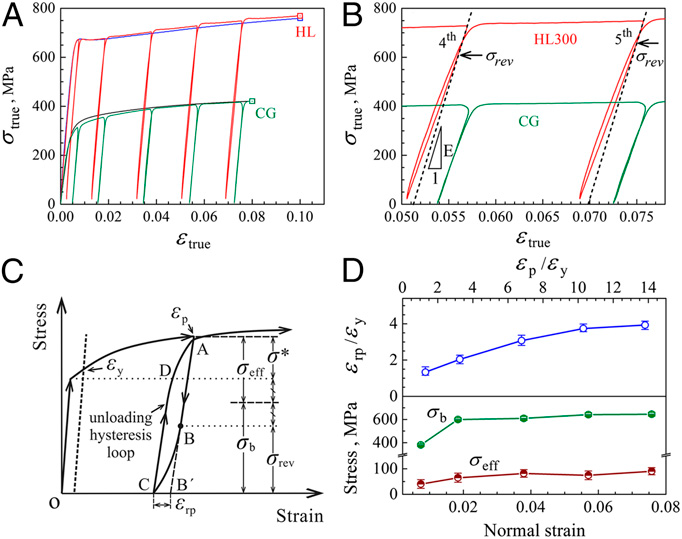
The very first thing that we should know is that a heterogeneous microstructure does not necessarily behave as an effective heterostructure. The presence of regions with different grain sizes, dislocation densities, or recrystallization states only establishes structural heterogeneity. For these regions to produce a meaningful synergistic mechanical response, they must interact during deformation. The loading-unloading-reloading test, commonly known as the LUR test, is one of the most widely used methods for investigating this interaction and estimating the internal stress that develops between mechanically dissimilar zones [1,2]
Why Is the LUR Test Needed?
During tensile deformation, the mechanically softer zones of a heterostructured material usually begin plastic deformation before the harder zones. The hard zones initially remain elastic or accumulate less plastic strain, thereby constraining the deformation of their softer neighbors. This difference produces strain partitioning and a gradual buildup of strain gradients near hetero-zone boundaries [1,4].
Because the soft and hard zones are physically connected, they cannot deform independently. Additional dislocations are required to maintain deformation compatibility across their boundaries. These geometrically necessary dislocations, or GNDs, generate long-range internal stresses: a back stress that opposes continued plastic flow in the soft zones, and a corresponding forward stress that assists deformation in the hard zones [1,2,4].
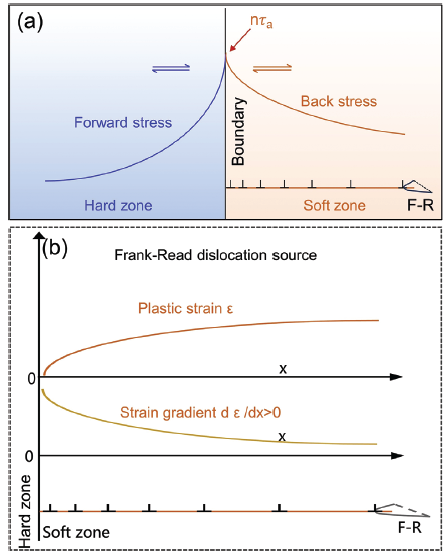
The combined internal stress field is commonly described as the hetero-deformation-induced stress, or HDI stress. Its development can raise the apparent yield strength of the soft zones and provide additional strain hardening after yielding [1,4].
However, neither a conventional tensile curve nor a microstructural map directly reveals the magnitude of this directional internal stress. A tensile curve shows the overall response of the material, while techniques such as EBSD reveal differences in grain structure, recrystallization state, and local orientation gradients. The LUR test is needed because it probes how the material responds when the direction of plastic flow is temporarily reversed and then restored.
The Scientific Basis: The Bauschinger Effect
The theoretical foundation of the LUR test is the Bauschinger effect. When a material is plastically deformed in one direction, its subsequent yielding behavior becomes direction-dependent. If the loading direction is reversed, plastic flow begins at a lower stress magnitude than would be expected from the original forward-loading curve.
This behavior originates from the internal stress field created during the initial deformation. During forward loading, the back stress opposes the motion of dislocations. During unloading and reverse deformation, the same internal stress assists dislocation motion in the reverse direction. As a result, reverse plasticity may begin even while the externally applied stress is still tensile [4].
In an ideal elastic unloading process, the unloading path would remain linear with a slope close to the elastic modulus. In a material with substantial internal back stress, the unloading curve begins to deviate from this elastic path as reverse plastic flow develops. During reloading, another deviation occurs when forward plastic flow resumes. Together, these deviations create a hysteresis loop.
A wider and more pronounced loop generally indicates a stronger Bauschinger response and a larger directional internal stress. In heterogeneous lamellar titanium, for example, pronounced hysteresis loops were observed even near the initial yielding stage, whereas the homogeneous coarse-grained reference showed little hysteresis [4].
How Is the LUR Test Conducted?
The specimen is first loaded in tension to a predetermined strain. Instead of continuing directly to fracture, the applied load is reduced to a low value without necessarily placing the specimen under compression. The specimen is then reloaded in tension until the original loading path is recovered. This sequence is repeated at progressively larger strains.
The test does not require complete stress reversal into macroscopic compression. Reverse plastic flow can begin during unloading while the measured engineering stress remains positive because the internal back stress acts opposite to the original plastic flow direction [4].
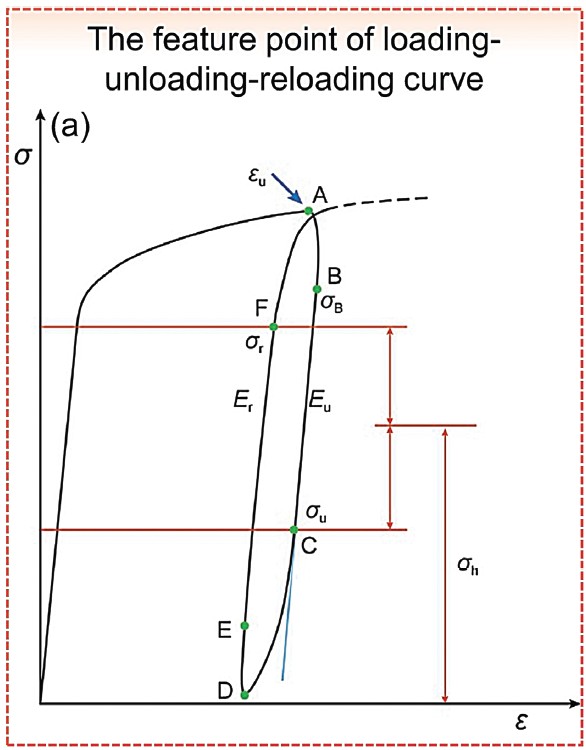
The unloading and reloading yield stresses are identified from the points at which the respective curves depart from their elastic paths. These values are then used to estimate HDI stress. A commonly used expression is:
where and represent the unloading and reloading yield stresses according to the sign convention adopted in the analysis [1,2]. The precise definitions and signs must be reported clearly because different studies may represent reverse yield stress differently.
The remaining part of the flow stress is often referred to as the effective stress:
The effective stress represents the combined resistance from mechanisms such as lattice friction, solid-solution strengthening, precipitates, grain boundaries, and short-range dislocation interactions. It should not be interpreted as a single strengthening contribution.
HDI Strengthening and HDI Strain Hardening
The magnitude of HDI stress at or near yielding contributes to HDI strengthening. It reflects the additional stress required for the soft zones to continue deforming while constrained by the neighboring hard zones.
The evolution of HDI stress after yielding is equally important. If HDI stress continues to rise with plastic strain, it provides an additional strain-hardening contribution:
This quantity is the HDI strain-hardening rate. It should be distinguished from the magnitude of HDI stress itself.
In the early elastoplastic stage, the soft zones yield while many hard zones remain elastic. The big difference in their deformation produces rapid GND accumulation and a steep increase in HDI stress. As loading continues, the hard zones progressively enter plastic deformation. The difference in plastic strain between the zones remains, but it usually becomes less severe, slowing the rate of HDI-stress increase. At larger strains, HDI stress may approach saturation as plastic accommodation improves and some GNDs are absorbed, transmitted, recovered, or rearranged near zone boundaries [1].
This evolution is important for ductility. According to the Considère criterion, tensile necking begins when the work-hardening rate falls to the level of the true flow stress:
By adding a sustained internal-stress contribution to the overall work-hardening rate, HDI strain hardening can delay this condition and increase uniform elongation [1,4].
Final Perspective
The value of the LUR test lies in its ability to connect a macroscopic mechanical response to an internal consequence of heterogeneous deformation. A material may contain visually distinct zones yet develop only weak mechanical interaction between them. Conversely, a carefully designed heterostructure can produce a strong Bauschinger effect and an increasing HDI stress because its soft and hard zones continuously constrain one another.
The most useful LUR result is therefore not simply the largest hysteresis loop or the highest absolute HDI stress. A successful heterostructure should show a meaningful and sustained increase in HDI stress while maintaining an appropriate balance of yield strength, work-hardening capacity, and uniform elongation. The LUR test explains part of the mechanism, but the quality of the material must ultimately be judged from the combined microstructural and mechanical evidence.
References
[1] Zhu, Y., et al. “Heterostructured Materials: Superior Properties from Hetero-Zone Interaction.” Materials Research Letters, 9 (2021): 1–31. https://doi.org/10.1080/21663831.2020.1796836.
[2] Dong, X., et al. “Heterostructured Metallic Structural Materials: Research Methods, Properties, and Future Perspectives.” Advanced Functional Materials, 34 (2024): 2410521. https://doi.org/10.1002/adfm.202410521.
[4] Wu, X., et al. “Heterogeneous Lamella Structure Unites Ultrafine-Grain Strength with Coarse-Grain Ductility.” Proceedings of the National Academy of Sciences, 112 (2015): 14501–14505. https://doi.org/10.1073/pnas.1517193112.
[5] Gao, B., et al. “Heterostructure Enables New Deformation Mechanisms to Enhance Strength and Work Hardening.” Materials Research Letters, 13 (2025): 917–927. https://doi.org/10.1080/21663831.2025.2531071.
[6] Li, J., et al. “Unusual Deformation Mechanisms Evoked by Hetero-Zone Interaction in a Heterostructured FCC High-Entropy Alloy.” Acta Materialia, 282 (2025): 120516. https://doi.org/10.1016/j.actamat.2024.120516.