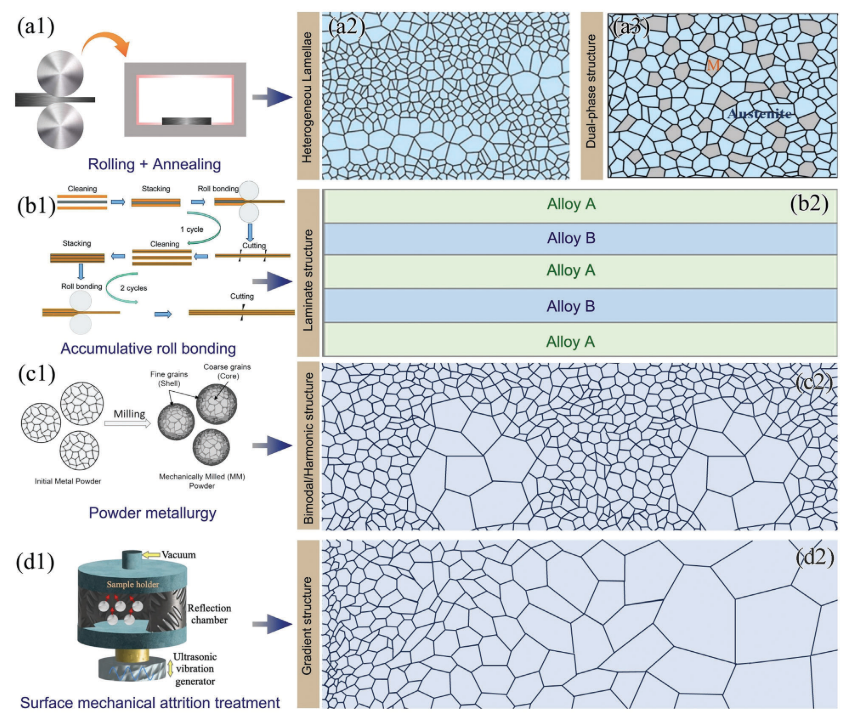
Heterostructured materials are a class of materials containing spatially distinct regions, commonly referred to as hetero-zones, with substantially different mechanical or physical properties [1,2]. These differences may originate from variations in grain size, dislocation density, phase constitution, chemical composition, crystallographic texture, or other microstructural characteristics. Accordingly, heterostructures may appear in several forms, including lamellar, bimodal, different types of gradient, laminated, dual-phase, and core-shell architectures [1,3]. What distinguishes an effective heterostructure from an ordinarily heterogeneous material is not merely the coexistence of dissimilar regions, but the significant mechanical interaction between them during [1]. During deformation, differences in yielding and plastic flow between soft and hard zones produce strain partitioning and strain gradients near region boundaries. The accommodation of these gradients promotes the formation and accumulation of geometrically necessary dislocations(GNDs), which generate long-range internal stresses and contribute to hetero-deformation-induced(HDI) strengthening and strain hardening [1,2,4]. Through these interactions, properly designed heterostructures can combine high strength with sustained work hardening, delaying the onset of necking according to the Considère criterion and enabling a level of uniform ductility that is generally unattainable in their homogeneous counterparts or through a simple rule of mixtures response [1,4]. Heterostructuring therefore represents a shift from the traditional pursuit of uniform microstructures toward the deliberate engineering of controlled heterogeneity for improved material performance [2,3].
Common Types of Heterostructured Materials
Heterostructured materials can be classified according to the spatial arrangement, morphology, and origin of their mechanically dissimilar zones. The most common architectures are introduced below [1,2].
1-Heterogeneous Lamellar Structures
Heterogeneous lamellar structures consist of alternating or interspersed elongated soft and hard zones. They are commonly produced by severe cold rolling followed by partial recrystallization, which converts selected high-stored-energy regions into recrystallized (soft) zones while other regions remain recovered or unrecrystallized (hard) zones [2,4]. This architecture has been reported in titanium, copper alloys, steels, high-entropy alloys, and aluminum alloys [2,3].
Strain partitioning develops because the mechanically softer lamellae yield and deform more readily than the surrounding hard lamellae. The elongated geometry, high interface density, and strong lateral constraint make the strain mismatch particularly effective in generating strain gradients and HDI stress [1,4].
2-Bimodal and Multimodal Structures
Bimodal structures contain two dominant microstructural populations, commonly coarse grains(soft) dispersed within a fine- or ultrafine-grained (hard) matrix. Multimodal materials contain three or more populations and may additionally include nanograins, precipitates, or reinforcing particles [1,2]. These structures can be produced through partial recrystallization, abnormal grain growth, powder metallurgy, or consolidation of powders with different initial particle sizes. Bimodal structures are common in copper, titanium, magnesium, aluminum alloys, and high-entropy alloys [1,3].
Strain partitioning generally arises from the difference in flow stress between the constituent populations. Clean coarse grains commonly act as soft zones, while fine or nanostructured regions act as hard zones. However, in partially recrystallized materials, small defect-free recrystallized grains may be softer than geometrically coarse but heavily subdivided unrecrystallized regions. Therefore, soft and hard zones must be identified from their mechanical response rather than grain size alone [1,6].
3-Gradient Structures
Gradient structures exhibit a gradual variation in grain size, dislocation density, twin density, chemical composition, phase fraction, or residual stress across the material [1,2]. They are commonly produced using surface mechanical treatments such as SMAT, SMGT, SMRT, ultrasonic surface rolling, pre-torsion, or controlled additive manufacturing. Gradient structures have been widely investigated in steels, copper, nickel, titanium, and aluminum alloys [2,3].
Strain partitioning develops continuously across the gradient because different depths possess different yield strengths and strain-hardening behaviors. A hard nanostructured surface tends to carry higher stress, while the softer interior accommodates greater plastic strain. The gradual mechanical transition produces distributed strain gradients rather than a single sharp soft-hard boundary [1,3].
4-Laminated Structures
Laminated heterostructures consist of alternating layers with different compositions, phases, grain sizes, or mechanical properties. They are commonly fabricated through accumulative roll bonding, diffusion bonding, electrodeposition, extrusion bonding, or additive manufacturing [1,2]. Representative systems include Cu/Nb, Ti/Nb, Cu/brass, Al/Al-alloy, and different combinations of aluminum alloys [1,3].
Strain partitioning occurs because the layers have different elastic moduli, yield strengths, and work-hardening capacities. The softer layers plastically deform first, while the harder layers initially remain elastic and carry an increasing fraction of the load. The bonding quality and thickness of the layers are particularly important because weak interfaces may delaminate before beneficial HDI effects can fully develop [1,2].
5-Dual- and Multi-Phase Structures
Dual- and multi-phase heterostructures contain phases with different compositions, crystal structures, or mechanical responses. Familiar examples include ferrite-martensite steels, austenite-ferrite alloys, multiphase titanium alloys, eutectic high-entropy alloys, and aluminum alloys containing mechanically distinct precipitates or second phases [1,2].
Strain partitioning originates from differences in phase strength, elastic response, slip systems, transformation behavior, and strain-hardening capacity. Soft phases usually accommodate more plastic strain, while hard phases carry greater stress. Phase boundaries constrain this mismatch and may promote GND accumulation, load transfer, phase transformation, or additional dislocation interactions [1,2]. The hard phases must remain sufficiently deformable, because an excessive strength contrast or a weak interface can instead promote stress concentration and early cracking [1].
6-Harmonic or Core-Shell Structures
Harmonic structures contain relatively coarse-grained cores surrounded by a continuous three-dimensional network of fine- or ultrafine-grained shells [1,2]. They are usually produced by mechanically deforming the surfaces of metallic powders, followed by consolidation through sintering or hot deformation. This architecture has been developed in nickel, titanium, stainless steel, cobalt alloys, and several powder-processed metallic systems [1,2].
The coarse cores generally act as strain-accommodating soft zones, while the continuous fine-grained shell network provides strength and constrains deformation. Strain partitioning occurs across the core-shell boundaries because the cores deform more readily than the surrounding shell. The continuity of the hard shell network is important for maintaining constraint and distributing plastic deformation throughout the material [1].
*Important Note
These classifications describe the geometry of heterogeneity, not a universal assignment of soft and hard regions. A coarse region is not necessarily soft, and a fine region is not necessarily hard. Flow stress also depends on dislocation density, internal subdivision, texture, solid-solution content, precipitates, and phase constitution. An effective heterostructure therefore requires not only distinguishable zones but also sufficient mechanical contrast, appropriate spatial arrangement, strong interfaces, and sustained interaction between the zones during deformation [1,2,6].
References
[1] Zhu, Y., et al. “Heterostructured Materials: Superior Properties from Hetero-Zone Interaction.” Materials Research Letters, 9 (2021): 1–31. https://doi.org/10.1080/21663831.2020.1796836.
[2] Dong, X., et al. “Heterostructured Metallic Structural Materials: Research Methods, Properties, and Future Perspectives.” Advanced Functional Materials, 34 (2024): 2410521. https://doi.org/10.1002/adfm.202410521.
[3] Liu, Y., et al. “Engineering Heterostructured Al Alloys via Advanced Processing: A Review on Processing Strategies, Microstructure, and Material Performance.” Journal of Materials Processing Technology, 353 (2026): 119368. https://doi.org/10.1016/j.jmatprotec.2026.119368.
[4] Wu, X., et al. “Heterogeneous Lamella Structure Unites Ultrafine-Grain Strength with Coarse-Grain Ductility.” Proceedings of the National Academy of Sciences, 112 (2015): 14501–14505. https://doi.org/10.1073/pnas.1517193112.
[5] Gao, B. et al. “Heterostructure Enables New Deformation Mechanisms to Enhance Strength and Work Hardening.” Materials Research Letters, 13 (2025): 917–927. https://doi.org/10.1080/21663831.2025.2531071.
[6] Li, J., et al. “Unusual Deformation Mechanisms Evoked by Hetero-Zone Interaction in a Heterostructured FCC High-Entropy Alloy.” Acta Materialia, 282 (2025): 120516. https://doi.org/10.1016/j.actamat.2024.120516.