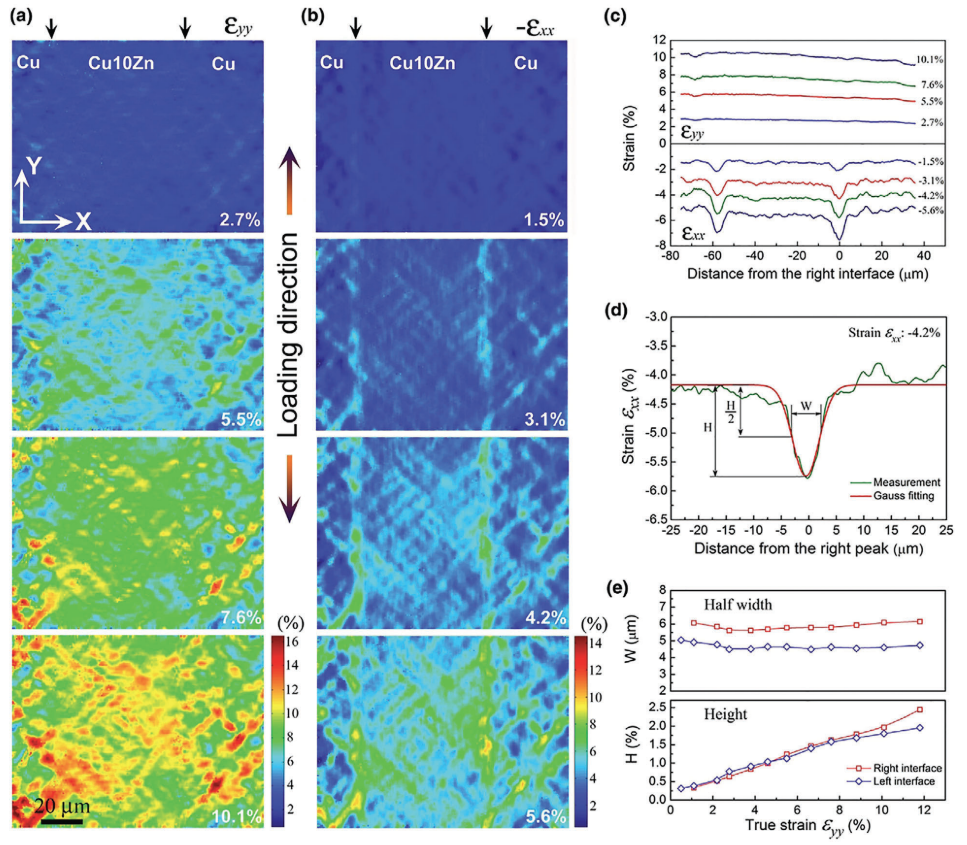
Heterostructured materials contain mechanically dissimilar zones that do not necessarily carry the same amount of plastic strain. After yielding, softer zones generally deform more readily, while harder zones constrain their deformation. This difference is known as strain partitioning and is one of the central origins of hetero-zone interaction [1,2]. Because neighboring zones remain physically connected, their deformation must remain compatible across the hetero-zone boundary. The difference in plastic strain therefore produces a local strain gradient, encouraging the development of GNDs and internal stresses [1,2].
Why Is In-Situ DIC Needed?
A conventional tensile test measures the average deformation of the gauge section. It cannot determine whether the soft and hard zones carry equal or different amounts of strain. Digital Image Correlation, or DIC, addresses this limitation by measuring full-field surface displacement from a sequence of images recorded during deformation. When applied at microscopic resolution and aligned with an EBSD map, DIC can connect the measured strain field to specific soft and hard zones [2,6].
The main question behind the test is:
Do the mechanically dissimilar zones genuinely deform by different amounts during loading?
What Does the Test Reveal?
In-situ DIC can reveal:
- the onset and evolution of strain partitioning;
- the average strain carried by soft and hard zones;
- strain gradients near hetero-zone boundaries;
- the location and development of strain localization;
- the formation, propagation, and arrest of strain bands;
- whether deformation remains distributed or develops into one dominant localization path.
In a heterostructured FCC alloy, microscopic DIC showed that the hard non-recrystallized zones accommodated substantial plastic strain through dispersed, stable strain bands. Their propagation was restricted by hetero-zone boundaries and neighboring soft recrystallized regions, preventing rapid localization into a single dominant band [6](For more detail, you can read more in the “Strain-Band Evolution in Heterostructured Materials” post).
Important Limitations
DIC measures deformation only on the observed surface. Its spatial resolution depends on the imaging system, speckle size, subset dimensions, and image quality.
For grain or zone-scale strain partitioning, conventional macroscopic DIC is generally insufficient. Micro-DIC or SEM-DIC aligned with EBSD is preferred because EBSD identifies the hetero-zones while DIC measures their local deformation [2,6].
DIC alone also cannot directly identify GNDs or calculate HDI stress. Those interpretations require complementary evidence from EBSD, TEM, or LUR testing.
Final Perspective
In-situ DIC is valuable because it tests the central mechanical assumption behind heterostructured materials: soft and hard zones deform differently but remain mutually constrained. If the measured strain field consistently follows the hetero-zone architecture, strain partitioning is no longer merely inferred from the microstructure. It is directly observed during deformation.
References
[1] Zhu, Y., et al. “Heterostructured Materials: Superior Properties from Hetero-Zone Interaction.” Materials Research Letters, 9 (2021): 1–31. https://doi.org/10.1080/21663831.2020.1796836.
[2] Dong, X., et al. “Heterostructured Metallic Structural Materials: Research Methods, Properties, and Future Perspectives.” Advanced Functional Materials, 34 (2024): 2410521. https://doi.org/10.1002/adfm.202410521.
[6] Li, J., et al. “Unusual Deformation Mechanisms Evoked by Hetero-Zone Interaction in a Heterostructured FCC High-Entropy Alloy.” Acta Materialia, 282 (2025): 120516. https://doi.org/10.1016/j.actamat.2024.120516.