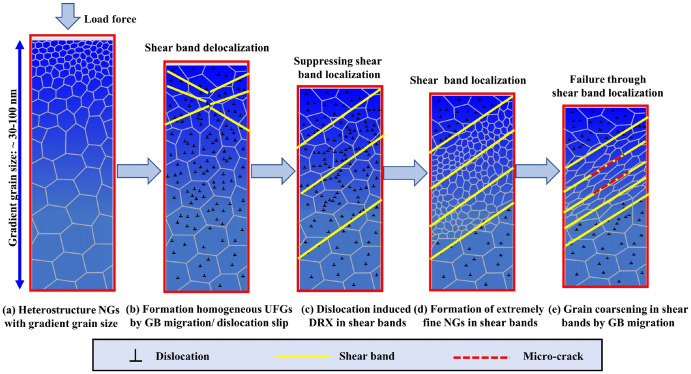
Strain bands are narrow regions in which plastic strain becomes concentrated relative to the surrounding material. They are particularly common in ultrafine-grained and nanostructured regions because these structures generally have limited capacity for sustained dislocation storage and work hardening. Once a local band begins to deform, the resistance within that path may not increase sufficiently to redirect deformation elsewhere [1,2].
In a homogeneous nanostructured material, several small strain-band embryos may initially form after yielding. However, because the surrounding microstructure provides little mechanical contrast or external constraint, one favorably oriented band can accumulate strain faster than the others. This dominant band may merge with neighboring bands and propagate through the gauge section, eventually controlling macroscopic localization and necking [2].
The path is different in a heterostructured material. When a strain band develops inside a hard nanostructured or non-recrystallized zone and approaches a hetero-zone boundary, its propagation is influenced by the neighboring soft zone. The soft zone can plastically accommodate part of the local strain and reduce the stress concentration at the band tip. At the same time, mechanical constraint across the boundary makes it more difficult for the band to continue along its original path [1,2].
Depending on the local microstructure, a strain band may therefore:
- terminate or weaken near a hetero-zone boundary;
- change direction as it approaches the boundary;
- enter the neighboring soft zone with reduced intensity;
- transfer deformation to a different slip path;
- or remain confined within the hard zone while new bands form elsewhere [2].
Because the first bands are restricted before becoming dominant, new strain bands can nucleate in previously less-deformed regions. The result is a population of dispersed bands that develop together rather than one localized path carrying most of the plastic strain [1,2].
Microscopic DIC has shown this behavior in a partially recrystallized heterostructured FCC alloy. Numerous stable strain bands formed inside the hard, non-recrystallized lamellae. The bands became weaker near the hetero-zone boundaries, and some propagated into the neighboring recrystallized matrix with noticeable attenuation. This allowed the hard zones to accommodate substantial plastic strain without developing the rapid instability observed in their homogeneous nanostructured counterparts [2].
The term stable strain band does not mean that the band remains stationary or carries no additional strain. Stability means that the band can continue accommodating deformation without immediately coalescing into a single catastrophic localization path. In the cited study, the intensity of the bands increased with applied strain, while their characteristic width remained approximately stable and neighboring bands continued to develop side by side [2].
This behavior improves ductility through strain delocalization. Plastic deformation remains heterogeneous at the microscopic scale, but it becomes more evenly distributed across the material at the macroscopic scale:
This mechanism complements HDI strain hardening. HDI strain hardening increases resistance to continued plastic flow, while dispersed strain bands prevent that flow from collapsing into one dominant localization path. Together, these mechanisms delay necking and improve uniform elongation [1,2].
It is more accurate to use the term strain band when discussing DIC results. DIC measures localized components of surface strain, but does not by itself establish that deformation inside a band is dominated by shear. The term shear band should therefore be reserved for cases where the shear character has been independently demonstrated.
References
[1] Zhu, Y., et al. “Heterostructured Materials: Superior Properties from Hetero-Zone Interaction.” Materials Research Letters, 9 (2021): 1–31. https://doi.org/10.1080/21663831.2020.1796836.
[2] Li, J., et al. “Unusual Deformation Mechanisms Evoked by Hetero-Zone Interaction in a Heterostructured FCC High-Entropy Alloy.” Acta Materialia, 282 (2025): 120516. https://doi.org/10.1016/j.actamat.2024.120516.